
Webster Athens Students Bring Fresh Perspectives to Global RAD Event
December 22, 2025
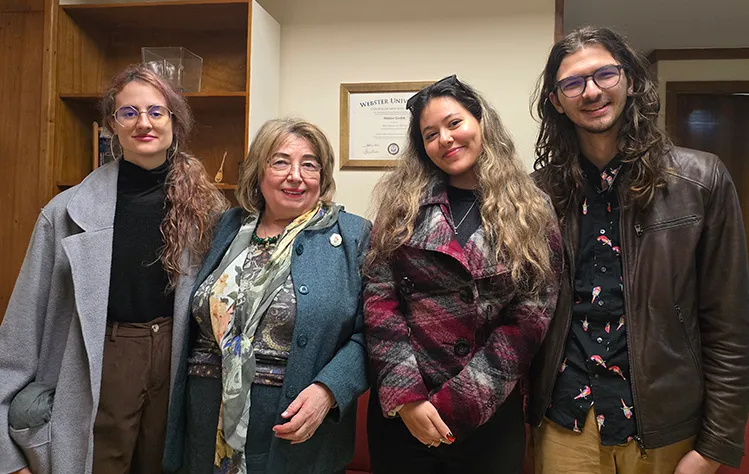 Webster Athens students Veronika Tomchani, from left, Vice Rector for Academic Affairs
Dr. Susie Michailidis, Natalina Hanna and Study Abroad student Brianna Neighbors before
presenting their work to an international audience at the RAD Conference.
Webster Athens students Veronika Tomchani, from left, Vice Rector for Academic Affairs
Dr. Susie Michailidis, Natalina Hanna and Study Abroad student Brianna Neighbors before
presenting their work to an international audience at the RAD Conference.
Webster Athens students participated virtually on Dec. 5 in the Fall Research Across Disciplines (RAD) 2025 Conference, hosted by Webster University’s main campus in St. Louis, Missouri — an event that showcases outstanding student work across programs and global campuses.
Held twice a year at the end of each semester, RAD provides undergraduate and graduate students — domestic and international — the opportunity to present their research and academic accomplishments.
This Fall, three Webster Athens students presented their work to an international academic audience:
- Natalina Hanna, International Relations — “The Rise of a Surveillance State and Its Impact on Human Rights.
- Veronika Tomchani, English — “Hermenia, Signs and Words: Language & Reality.”
- Brianna Neighbors, Film, TV and Video Production; History, Study Abroad student at Webster Athens — “Meditation and Tranquility and Their Relationship to the Body, Soul and Mind.”
Their research reflects the interdisciplinary spirit of RAD and the academic excellence of Webster students across the humanities and social sciences.
"Research activity is fundamental for University students on undergraduate and graduate levels as this enables them to develop independent critical thinking, building up innovation ability by connecting theory to real-world application,” said Vice Rector of Academic Affairs Susie Michailidis, PhD. “The RAD Conference is a significant event at Webster University pointing out the commitment to the importance of students' scholarship, which enables learners to have better oral and written communication skills, boosting motivation and curiosity while preparing students to challenge complex issues in any field.”
Are the Meaning of Signs and Words Meaningful?
Tomchani noted the value of the event, “As always, the RAD Conference is a wonderful learning experience — both in acquiring and sharing knowledge. This international, intercampus event promotes the Webster spirit of encouraging curiosity, growth and understanding.”
In her research, “Hermenia, Signs and Words: Language & Reality,” Tomchani explored the meaning of signs and words and the relationship between language and reality through the ideas of four thinkers: Plato, Aristotle, Sartre and Baudrillard.
“There is a symbiotic nature between language and reality. The question of which shapes the other is irrelevant, as they work in tandem,” she explained. “Signs — whether in ancient or modern society — are interpreted and internalized by individuals. Language, much like the human essence, demands interpretation. It is the person who gives meaning, because meaning cannot exist on its own.”
Intruding Personal Freedoms to Enhance National Security
Hanna’s research, “The Rise of a Surveillance State and Its Impact on Human Rights,” examines the emergence of surveillance states with a focus on North Korea. “The study considers how modern surveillance technologies — such as data collection, electronic monitoring and biometric identification — are used both to intrude on personal freedoms and to enhance national security,” she said. “It looks at how the North Korean regime imposes control through strict communication restrictions, pervasive Internet monitoring and intrusive technologies designed to silence dissent.”
Highlighting the risks of security being prioritized above civil liberties, Hanna emphasized that her study reveals the lived experiences of North Koreans in a tightly controlled society. The research concludes that national security is often used as justification for surveillance, contributing to severe human rights violations and raising critical ethical questions about state authority.
Connecting Ancient Philosophy and History to Modern Media
Neighbors expressed appreciation for the platform RAD provides: “Thank you very much for allowing me the opportunity to discuss the significance and connections between our history and modern media. It is a great honor, and I’m very proud to have shared my research.”
Neighbors' paper explores meditation and tranquility and their relationship to the mind, body and soul, drawing from works by Marcus Aurelius and Seneca. “I write through a blend of fact, opinion and fiction, using modern examples to deepen comprehension of the topic and its relevance to today’s world,” Neighbors said. References from contemporary films — such as “Fantastic Mr. Fox” by Wes Anderson and “The Truman Show” by Peter Weir — help illustrates Seneca’s points on tranquility and its role in achieving peace.
Neighbors also examined Marcus Aurelius’ views on the differing experiences of the mind, body and soul, and his belief in turning inward through meditation while acting with integrity. To connect ancient philosophy to modern media, Neighbors analyzed films such as “Black Swan” by Darren Aronofsky, “Superman” by James Gunn and “Star Wars Episode III: Revenge of the Sith” by George Lucas. The paper concludes with reflections on how history shapes media and will continue to influence future creators.
About Webster Athens
Established in 2014, Webster Athens is the only fully owned and accredited U.S. university campus in Greece. It offers globally focused academic programs designed to prepare students with the skills and perspectives needed to thrive in an interconnected world. For more information about programs and scholarship opportunities, contact Webster Athens Admissions.